Harry Edward Nilsson III successfully balanced commercial appeal and cult success in the 1960s and 1970s. He enjoyed hit singles like ‘Everybody’s Talkin” and ‘Without You’.
But he followed an idiosyncratic path. In the early 1970s, he released a Randy Newman covers album, a standards album, and a soundtrack to an animated movie. Uniquely, he was both an accomplished songwriter and a gifted interpreter of other people’s songs. He wrote hits for Three Dog Night and Mary Hopkin, but some of his best-known hits were covers.
Nilsson started his music career singing demos for songwriter Scott Turner. He then worked as a songwriter with Phil Spector. The Beach Boys-inspired ‘This Could Be The Night’ is an early highlight. Arranger George Tipton was an early ally, spending his life savings to finance Nilsson’s early singles.
Nilsson’s career faded after the mid-1970s. He shredded his voice recording Pussy Cats with John Lennon, and largely retired from music after 1980’s Flash Harry. He was working on a comeback album when he passed away from heart disease in his early fifties.
Harry Nilsson Album Reviews
Spotlight on Nilsson

1966, 6/10
Nilsson’s first LP is a collection of his early singles, released on Tower, a budget imprint of Capitol Records. Glenn Tipton financed these early singles and arranged them. The recordings are basic – the ten tracks flash by in just over twenty minutes. It doesn’t have much of Nilsson’s musical personality, as it lacks his intricate backing vocal arrangements.
But it has a lyrical personality – even though a lot of the songs are covers, and were released as singles, they form a coherent narrative, with Nilsson a downtrodden, romantic loser. ‘Good Times’ later became the title track to The Monkees’ final album in 2016. It’s more country-oriented than anything else in his discography – he covers Merle Travis and Marvin Rainwater.
In hindsight, Spotlight is more like an interesting prelude to Nilsson’s discography proper, but it’s worth hearing.
Pandemonium Shadow Show

1967, 7/10
Harry Nilsson signed with RCA Victor in 1967, starting a partnership with arranger George Tipton. Nilsson constructs elaborate backing vocals, overdubbing himself in “a chorus of ninety-eight voices”. With the orchestral arrangements, it’s comparable to Scott Walker’s 1960’s work. But it’s quite different – Nilsson’s much cuddlier, and there’s only a hint of darkness to most of these tunes. Nilsson only wrote half of these tunes. If you’re a pop/rock fan, you’ll probably find his later albums more approachable, but it’s worth checking through here for gems.
Chief among the gems is ‘1941’, a biographical tale that Nilsson named after his year of birth. He also wrote ‘Ten Little Indians’ about the Ten Commandments, which later became a minor hit for The Yardbirds. A variety of artists later covered ‘Without Her’, including Glen Campbell and Blood, Sweat and Tears.
It’s fun hearing him mimic Lennon’s Greek chorus vocals on ‘She’s Leaving Home’. He also covers The Beatles’ ‘You Can’t Do That’, quoting seventeen other Beatles songs in the process.
Pandemonium Shadow Show is worthwhile, but Nilsson became more interesting as his songwriting developed.
Aerial Ballet

1968, 8/10
Aerial Ballet is named for the high-wire circus act that Nilsson’s grandparents developed. It’s a step forward – the baroque arrangements are pushed to the background, making it feel more intimate. Nilsson wrote almost all of the songs – the exception is the hit cover of Fred Neil’s ‘Everybody’s Talkin”. It feels much stronger, although its success was belated. ‘Everybody’s Talkin” became a hit when it was featured in 1969’s Midnight Cowboy, while ‘One’ was later a hit for Three Dog Night.
The opener, ‘Daddy’s Song’, was removed after the first copies were pressed, as the Monkees had paid for exclusive rights to record it for Head. It was restored to later pressings, with Nilsson singing the horn breaks. Nilsson would soon toughen his approach, but there’s plenty of whimsy like ‘Little Cowboy’ and ‘Good Old Desk’.
Nilsson’s skills as a writer and an interpreter grew on Aerial Ballet, and it contains two of his best-loved tracks.
Skidoo

1968, not rated
Nilsson provided the soundtrack for this 1968 comedy film. It’s largely instrumental, but the vocal numbers are solid songs in his 1960s style. The opener ‘The Cast and Crew’ is charming, with Nilsson singing the end credits, while ‘I Will Take You There’ is also worthwhile. Nilsson’s credited as the composer, but it seems like that arranger George Tipton wrote most of the score.
Harry

1969, 7.5/10
Harry feels like a backward step after Aerial Ballet. It’s half covers, and it often delves into pre-rock styles like Tin Pan Alley. I’m less interested in Nilsson covering ‘Mr Bojangles’ and The Beatles’ ‘Mother Nature’s Son’.
Meanwhile, ‘I Guess the Lord Must Be in New York City’ feels like a retread of ‘Everybody’s Talkin’.’ Nilsson wrote it for Midnight Cowboy when the director requested another song that sounded like ‘Everybody’s Talkin’.’
Nilsson cowrote ‘Rainmaker’ with William “Bill” Martin – Martin also wrote ‘Fairfax Rag’ and ‘City Life’. ‘Rainmaker’ points the way forward to his rock-oriented work in the early 1970s – the opening beat has been sampled by The Roots and Cypress Hill. My favourite cover is Randy Newman’s ‘Simon Smith and His Amazing Dancing Bear’ – Nilsson’s next album was entirely Newman covers.
Harry is solid, but it doesn’t emphasise my favourite parts of Nilsson’s style.
Nilsson Sings Newman
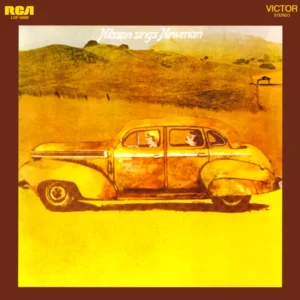
1970, 7/10
After Nilsson covered Newman’s ‘Simon Smith and His Amazing Dancing Bear’ on the previous album, the two teamed up for a full collaboration. Sonically, it’s one of Nilsson’s most fascinating projects. Newman’s piano is the main accompaniment, giving Nilsson lots of space to build intricate vocal arrangements – there are reportedly 118 overdubs on a single track here. Nilsson also breaks the fourth wall, sometimes speaking to the engineer.
Nilsson Sings Newman is a cult favourite, beloved by artists as diverse as Jellyfish, Adrian Belew, and Joanna Newsom. But I find it less enchanting than the great albums Newman and Nilsson would release separately in the early 1970s.
There are some great moments. Nilsson pushes his voice to extremes on ‘Cowboy’, places Newman’s limited voice could never go. Nilsson’s version of ‘The Beehive State’ is also much stronger than Newman’s – he captures the vibe of a senator promoting Utah.
I’m probably in the minority here, but I strongly favour Nilsson and Newman’s subsequent solo records to this collaboration.
The Point!
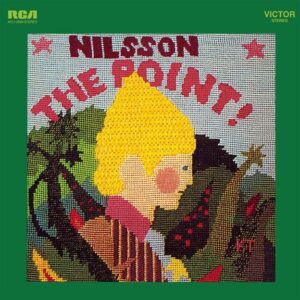
1970, 8.5/10
Nilsson took an acid trip. Staring at a tree, he realised that “they all came to points, and the little branches came to points, and the houses [each] came to [a] point. I thought, ‘Oh! Everything has a point, and if it doesn’t, then there’s [still] a point to it.'” These acid-fuelled insights formed the basis for The Point!
It’s a multimedia project – on the album, Nilsson alternates narrative tracks with songs. On the original TV broadcast, Dustin Hoffman provided narration. It was later adapted into a stage show.
It sounds goofy, but it works as an album. Nilsson’s narrations are succinct and interesting, and the songs are strong. It uses a gentle Beach Boys/Beatles sound, sophisticated but not overbearing. Songs like ‘Me and My Arrow’ and ‘Think About Your Troubles’ are excellent Nilsson songs, with a life outside of the musical. The gospel of ‘Down in the Valley’ is an excellent bonus track too.
The Point! is charming and unexpectedly satisfying.
Aerial Pandemonium Ballet

1971, not rated
Nilsson was full of innovative ideas during the early 1970s. With his first two RCA Victor albums out of print, he reimagined them, remixing, tweaking, and re-recording vocals. It’s considered one of the first remix albums.
Nilsson Schmilsson

1971, 9/10
Nilsson reinvented himself with his first album of original songs in the 1970s. He fell out with Tipton, instead travelling to London to work with producer Richard Perry. Perry was the it producer of the early 1970s – Village Voice reported that “the rungs on the ladder of success seem so much closer together when Perry is your guide.”
Nilsson doesn’t lose the things that made him interesting, like his vocal virtuosity, his whimsy, and his adventurousness. But Perry gives him access to more sounds, like the tough rocker ‘Jump Into The Fire’. And Perry doesn’t streamline Nilsson for the mainstream – it’s his most diverse album yet, ranging from novelty of ‘Coconut’ to the epic balladry of ‘Without You’.
Those are three of Nilsson’s best-loved songs, but there’s plenty beneath the surface. Nilsson combines spooky organ with bluesy vocals on a cover of Louis Jordan’s ‘Early in the Morning’. ‘The Moonbeam Song’ could have easily fitted onto his late 1960s records, but here it’s stripped back and charming. ‘Down’ is a nice bluesy rocker, while the closer ‘I’ll Never Leave You’ is restrained and minimal.
Nilsson Schmilsson is a triumph, introducing Harry to a wider audience without sacrificing his individuality.
Son of Schmilsson

1972, 8.5/10
Nilsson reunited with Richard Perry in London for the sequel to Nilsson Schmilsson. But the results are weirder and less disciplined – the vampire-posing cover is a good summation of how seriously Nilsson is taking the project. Nilsson’s songwriting touch hasn’t deserted him, but he uses it for weird ends. The oddities include the sing-along chorus of old folks on “I’d rather be dead than wet my bed” and the country-flavoured ‘Joy’, which Nilsson released as a single under the pseudonym Buck Earl. ‘Ambush’ is an anti-war song, with a raw sound and loaded with dark humour.
Son of Schmilsson is odd, but clearly one of Nilsson’s best. ‘Spaceman’ deserves to be recognised alongside ‘Rocketman’ and ‘Space Oddity’ as a classic of the lost-in-space genre. ‘You’re Breakin’ My Heart’ features one of the first uses of an f-word in popular music, while ‘The Lottery Song’ is a lovely, subtle gem. ‘Remember (Christmas)’ is pretty and low key as well.
Son of Schmilsson is deeply weird, but Nilsson’s still in prime form anyway.
A Little Touch of Schmilsson in the Night
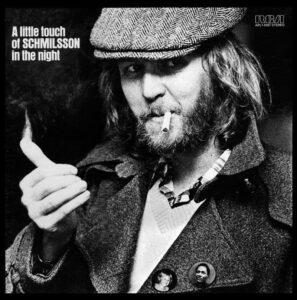
1973, 7.5/10
Pop singers making standards albums is passe now – Bob Dylan has made three. But Nilsson was one of the first to dig up songs from the pre-rock era. The album originated from games between Derek Taylor and Nilsson, where they’d challenge each other to identify the composers of obscure songs.
Richard Perry was unimpressed, labelling the album as “career suicide”. But in hindsight, Nilsson made A Little Touch just in time, before his voice was damaged by the Pussy Cats sessions. Nilsson worked with Gordon Jenkins, who arranged Frank Sinatra’s classic albums.

My edition has eighteen tracks, including the six outtakes that were later released on 1988’s A Touch More Schmilsson In The Night. It feels like too much of a good thing, with not enough stylistic variation. But it’s strong, especially when Nilsson’s sense of humour shines through on songs like ‘It Had To Be You’ (with bizarre reworked lyrics) and ‘Makin’ Whoopee!!’.
A Little Touch of Schmilsson in the Night is a fascinating and successful career detour from Nilsson.
Pussy Cats
1974, 8/10
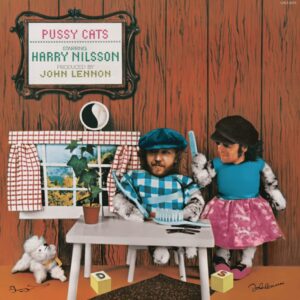
Harry Nilsson and John Lennon recorded Pussy Cats together during Lennon’s famous “Lost Weekend”. Lennon’s credited on the cover, but his role is strictly as producer – he doesn’t sing or play any instruments here. But his sonic stamp is clear – songs like ‘Save The Last Dance For Me’ feature his woozy string-driven sound, like on his own ‘Mind Games’. On other tracks, he encourages Nilsson towards raw rock and roll, like he’d recorded for his own Rock and Roll album. The ten tracks are evenly divided between covers and originals.
Despite their rowdy behaviour, the album captures a kind of resigned sadness, similar to Neil Young‘s contemporary ditch trilogy. Nilsson ruptured a vocal cord during the recording sessions, hiding it from Lennon. His previously pristine vocals are rough at times, particularly on ‘Old Forgotten Soldier’.
Like Nilsson’s discography, Pussy Cats is sometimes brilliant and all over the place. There are beautiful songs like ‘Save The Last Dance For Me’ and ‘Many Rivers to Cross’, but the record tails off at the end with the sad rock-and-roll covers. ‘Don’t Forget Me’ is the emotional centrepoint, a heartfelt love song to his ex-wife – maybe some recompense for ‘You’re Breaking My Heart’.
Pussy Cats is a fascinating collaboration. Even though Lennon’s heavily involved, it’s an excellent microcosm of Nilsson’s career.
Duit on Mon Dei

1975, 5.5/10
Nilsson’s career stalled after Pussy Cats. As well as damaging his vocal cords, he’s less focused – the songwriting is hit and miss. Nilsson’s main collaborator is Van Dyke Parks, who helped turn Nilsson’s rough sketches into more realised songs. Parks described himself as Nilsson’s “musical secretary”, and he forged order out of the drug-fuelled chaos.
It’s hard not to like Nilsson, but he’s trying our patience here. He’s suddenly interested in steel drums, while lots of the songs feel like toss-offs. With his diminished voice and sudden heretical streak (his proposed title for the record was God’s Greatest Hits), he’s oddly reminiscent of Randy Newman.
It’s fun hearing a cast of great musicians like Gloria Jones, Dr John, and Jim Keltner playing Nilsson’s slight compositions. The most enjoyable songs hit a fun groove, like ‘It’s A Jungle Out There’ and ‘Kojak Columbo’. With the goofy tone, it’s harder for the mellow songs to connect, but there’s a nice stretch with ‘Salmon Falls’ and ‘Puget Sound’.
Duit on Mon Dei is very slight, but it’s enjoyable despite itself.
Sandman

1976, 5.5/10
Nilsson seems like he’s trying a bit harder here. He works with arranger Perry Botkin Jr., who provides an old-timey feel to songs like ‘Something True’. Nilsson produced Sandman, supported by mid-1970s mainstays like Klaus Voormann, Jim Keltner, Danny Kortchmar, Jesse Ed Davis, and Van Dyke Parks.
The first few songs explore a romantic, orchestral sound. It works, and it feels like a new innovation. The cover of Alex Harvey’s ‘I’ll Take A Tango’ is charming, while ‘Something Good’ is a lovely piano ballad.
But the second half descends back into silliness. ‘The Flying Saucer Song’ and ‘How To Write A Song’ are two of the worst numbers in Nilsson’s catalogue.
If you cut the second half off, there’s a pretty interesting EP here.
…That’s The Way It Is

1976, 5.5/10
RCA were anxious about Nilsson’s failing sales. They stepped in, insisting on covers and an outside producer. Nilsson complied, agreeing to retitle the record from his original idea – Eldridge & Beaver Cleaver U.S.A.
Saxophonist Trevor Lawrence is a strange choice as producer – it’s his first production job, and he favours syrupy orchestration. But Nilsson’s vocals have recovered from the trauma of Pussy Cats, and it’s fun hearing him deliver easy-listening covers like ‘Just One Look’. It’s less silly than his previous two records, which makes the inclusion of ‘Zombie Jamboree’ jarring.
Conversely, his cover of Randy Newman’s ‘Sail Away’ is excellent, and makes this record worth salvaging. The duet with Dr John on ‘Daylight’, one of two Nilsson originals on the record, is another keeper.
…That’s the Way It Is is the most consistent of Nilsson’s weird mid-1970s albums, but it’s the least interesting.
Knnillssonn

1977, 8/10
Nilsson redoubled his efforts for Knnillssonn, taking control of production. His voice had recovered from Pussy Cats, and he returned to the lush, baroque sounds of his 1960s records. It was a personal favourite of Nilsson, although it didn’t sell strongly. Elvis Presley, another RCA artist, passed away just after its release, leaving Knnillssonn underpromoted.
Arguably, the retro and sentimental Knnillson might have sold poorly anyway. But it’s clearly Nilsson’s best album in years, with well-constructed, heartfelt songs. The opening ‘All I Think About Is You’ is an obvious highlight, but there are plenty of memorable songs like ‘Lean on Me’ and ‘Blanket for a Sail’, both using sailing metaphors. Nilsson delves back into pre-rock styles with ‘Perfect Day’, a fitting conclusion that utilises the grit in his voice.
Nilsson’s also mostly successful with ‘Who Done It?’, a murder mystery set to music that withstands repeated listens.
Knnillssonn is a great artistic comeback from Nilsson – even if you skip his other albums after Pussy Cats, make sure you hear this one.
Flash Harry

1980, 6/10
Nilsson’s final studio album ends his career with a whimper, rather than a bang. It wasn’t released in the US, and the record company didn’t release a single. But it’s less jarring than his weird mid-1970s records, even if the arrangements are overly sentimental and it’s short on great songs. There’s an unexpected Monty Python tie-in – the record opens with Eric Idle singing an ode to Harry, and ends with a cover of ‘Always Look on the Bright Side of Life’.
It’s short on great songs. Nilsson’s recording of ‘Old Dirt Road’, a cowrite with Lennon that appeared on Walls and Bridges, is probably the most interesting thing here. And the cover of Rick L. Christian’s ‘I Don’t Need You’ feels like a calculated attempt to repeat the success of ‘Without You’ – Kenny Rogers enjoyed success with it in 1981.
Flash Harry is a step ahead of Nilsson’s confused mid-1970s work, but it’s still only interesting to hardcore fans.
Lost and Founnd
2019, 6.5/10
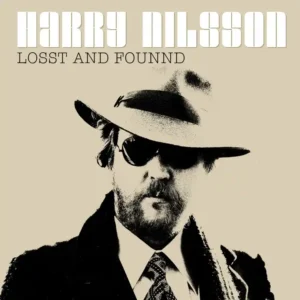
NIlsson largely stepped away from music after Flash Harry, only dabbling occasionally. But in the 1990s, he worked with producer Mark Hudson on a record titled Papa’s Got a Brown New Robe. It wasn’t finished when Nilsson passed away in 1994, and Hudson held on to the master tapes for 25 years. The original recordings were basic, Nilsson accompanying himself on a Casio keyboard.
In 2019, Hudson received a call from Nilsson’s estate and from Omnivore records, looking to complete the record. He recruited veteran drummer Jim Keltner and NIlsson’s son Kiefo on bass, as well as Van Dyke Parks and Jimmy Webb.
It seems likely that Nilsson’s silence during the 1980s and 1990s reflected his immersion in a happy home life. Songs like ‘Love Is the Answer’ and ‘Woman Oh Woman’ are charming, but Nilsson was wise to limit his output after 1980. It’s still one of his best post-Pussy Cats records – it’s fun on tracks like ‘Animal Farm’ and ‘Lost and Found’, even if none of the individual songs rank among Nilsson’s best.
It’s not a major work, but Lost and Founnd is a satisfying posthumous album from Nilsson.
20 Best Harry Nilsson Songs
- Don’t Forget Me
- Spaceman
- Coconut
- 1941
- Rainmaker
- Cowboy
- Jump Into The Fire
- All I Think About Is You
- Everybody’s Talkin’
- Without You
- Me and My Arrow
- Sail Away
- One
- Early in the Morning
- Think About Your Troubles
- Many Rivers to Cross
- The Lottery Song
- Down
- Makin’ Whoopee!!
- Down to the Valley.
The official Harry Nilsson website is excellent.


Read about the discographies of musical acts from the 1960s to the present day. Browse this site's review archives or enjoy these random selections:


I add new blog posts to this website every week. Browse the archives or enjoy these random selections:


Subscribe
Subscribe to receive new posts from Aphoristic Album Reviews.